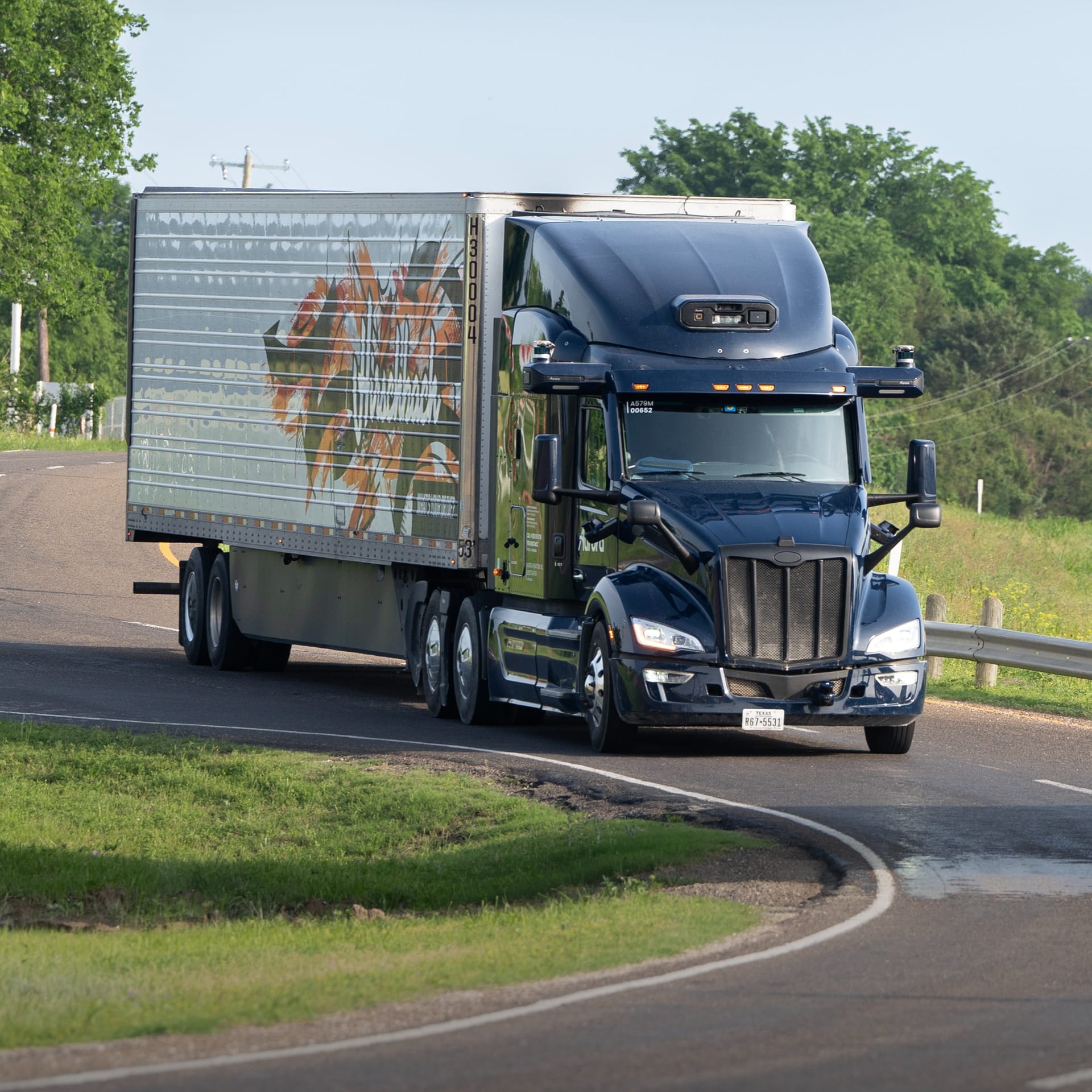
Three separate pieces of news from the past nine months keep bubbling up in my head and I want to put them in one place. They're the kind of thing that used to live in the "2030 outlook" section of every deck, and they've all quietly moved forward.
Driverless trucks started carrying real freight
In May 2025, Aurora Innovation launched the first fully driverless Class 8 truck service on US public highways. Dallas to Houston. No safety driver. Commercial freight for paying customers. Kodiak Robotics is right behind, with more than 5,200 hours of paid driverless service and over 3 million autonomous miles logged.

This isn't a pilot or a promo clip with a safety engineer in the cab. It's freight. Real freight. Somebody is paying somebody to move pallets using a truck that nobody is driving. McKinsey's January 2026 survey of operators puts widespread commercial deployment at three to seven years out, which I read as "closer to three on straight interstate runs and closer to seven on anything with mountain passes".
A port is running on a quantum computer
The Port of Los Angeles plugged in a hybrid quantum computing engine to optimise its container yard. The results came out earlier this year:
- Around 40 percent reduction in crane utilisation
- Over 60 percent more container throughput
- Hybrid quantum operations cutting overall operational cost by 12 to 18 percent
Broad commercial adoption of quantum in logistics is probably a 2030 to 2035 story. But the LA Port is now a reference everyone else will point at when evaluating whether to try it. One credible case study is enough to move a market.
Lights-out warehouses are still rare
Here's the counter-fact that keeps me honest: only 3 to 5 percent of warehouses today actually run in full lights-out mode. Most "automated" operations still have humans handling exceptions and edge cases. Interact Analysis projects 26 percent of warehouse space will have some form of automation by 2027 (not lights-out, just automation). Gartner is more aggressive: 75 percent of companies adopting cyber-physical automation by 2027, and 60 percent of supply chain disruptions resolved without human intervention by 2031.
What it does to my 2028 template
My 2028 solution design template has a new row on it. The row says: "does this design depend on a quantum system or not?" Which is a strange thing to put on a checklist, and also, here we are.
Also on the list: can this lane accept driverless Class 8 freight, and what's the humanoid assumption for 2029. Questions that would have been politely ignored in a customer meeting three years ago are now just part of the job. Strange times. Quietly good times, mostly.